 PosellaPosella
Non-players holding a guitar give themselves away instantly, because the fretting hand sits in the wrong place. This set shows where the left hand belongs on the neck and where the right hand should sit, so the shape reads as real.
Non-players holding a guitar give themselves away instantly, and it is always the hands. The left hand sitting too low on the neck, or fingers held straight instead of curled onto the frets, is the clearest tell. Curl four fingers onto frets near the top of the neck with your thumb behind it and the shape becomes convincing.
The right hand belongs near the soundhole, naturally curved, not laid stiffly across the strings. If you are unsure, catch yourself mid-strum — a hand in motion is far more forgiving than a hand holding a pose.
Compositionally, the body of the guitar is a large mass that easily hides you. Angle it rather than presenting it flat to the camera, and keep it from cutting across your face or neck. Seated poses are usually easier than standing with a strap, because sitting lets the instrument find its own natural position on your thigh.
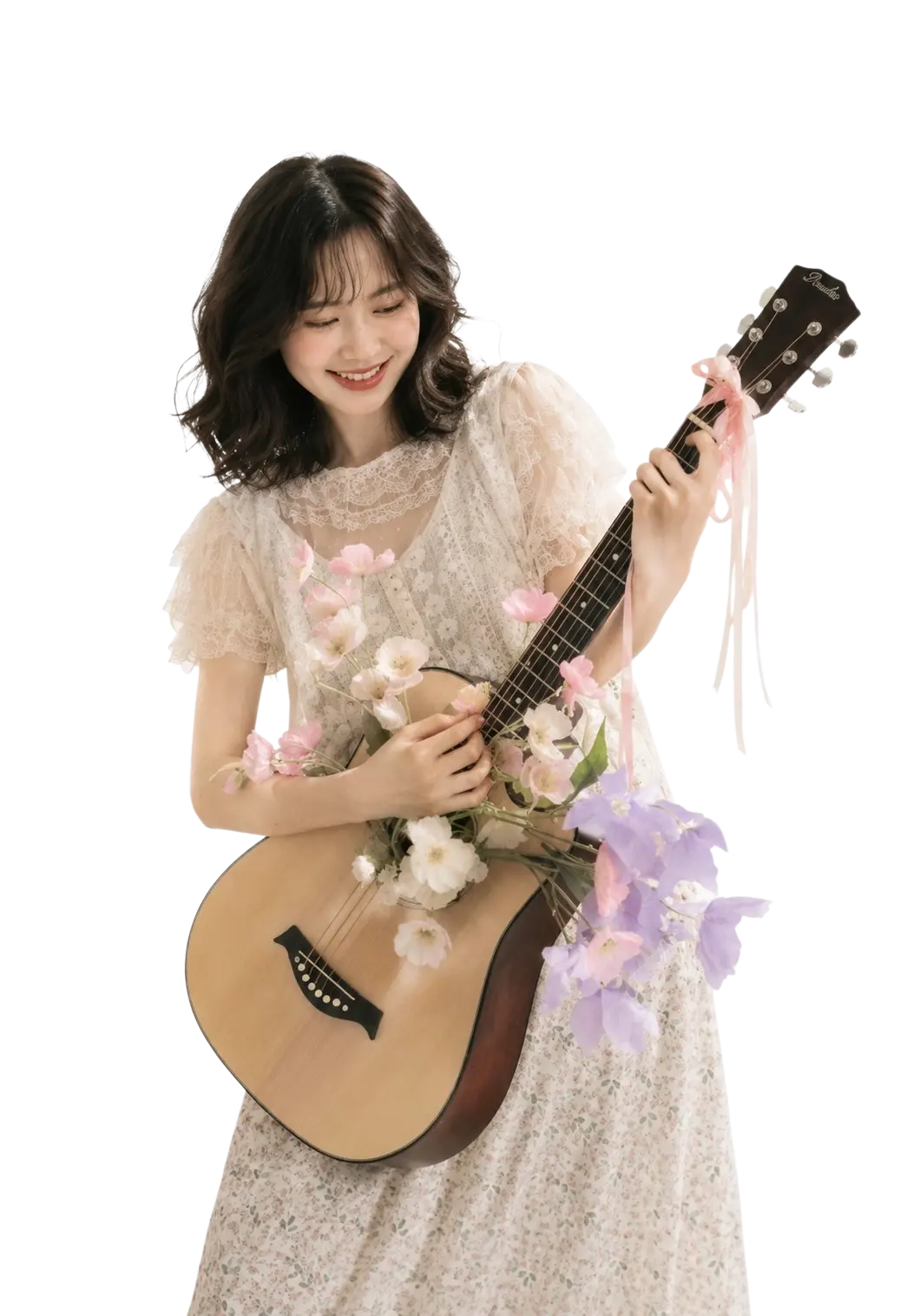


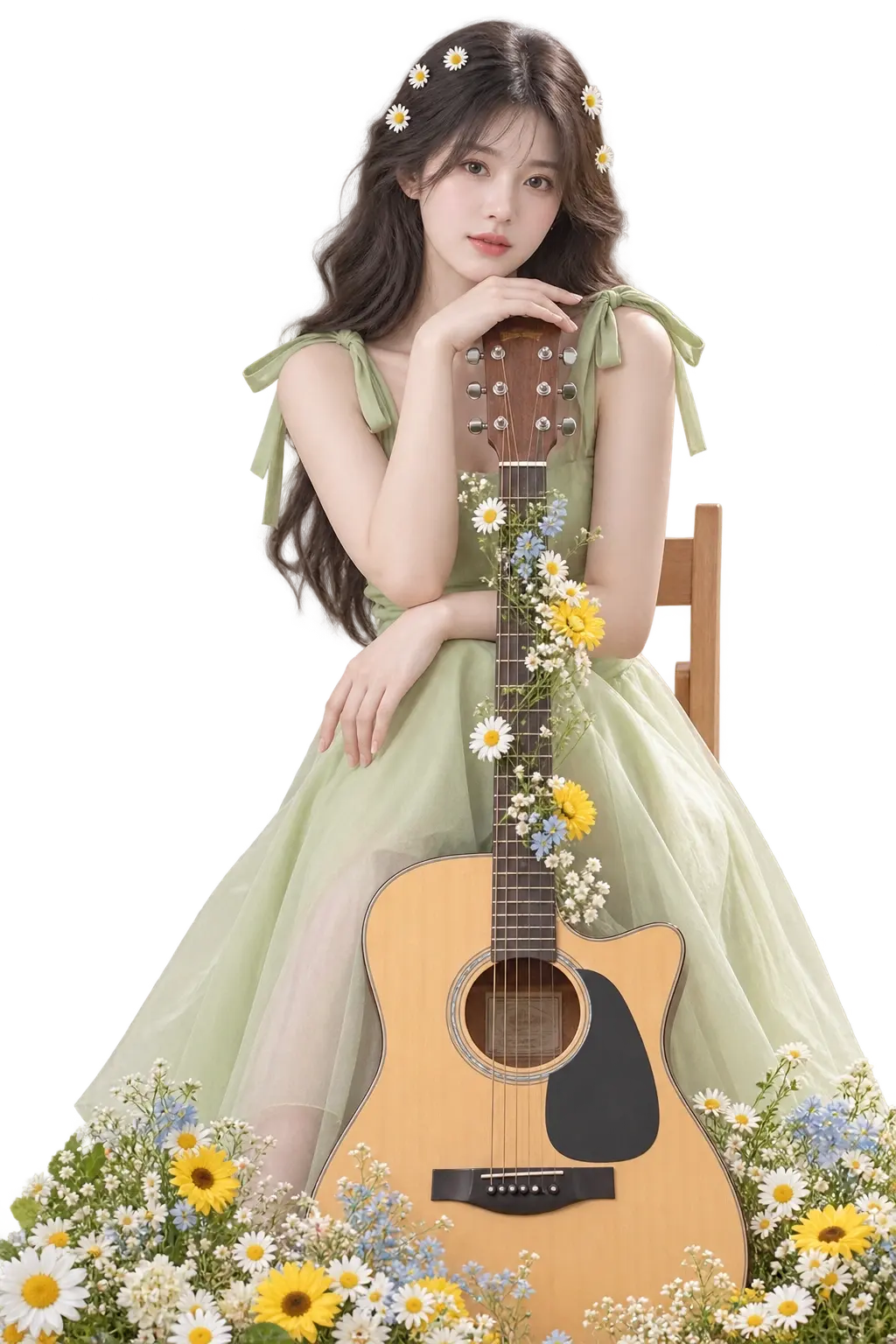

Showing 5 reference poses. Get the Posella app to see every pose in this setting and line up on them as you shoot.
Get it on Google PlayA guitar is a large shape, and held normally it covers most of the torso. Facing the camera square with the body of the guitar flat to the lens gives you a big oval blocking the middle of the frame, with the player largely disappearing behind it.
The fix is to turn thirty to forty-five degrees so the instrument turns with you, narrowing the oval into an ellipse and opening up the shoulders, neck and face. The neck of the guitar should angle upward rather than lie horizontal, because a diagonal leads the eye toward the face.
In this setting the most striking frames are usually not full-length but close on the hands — fingers on the fretboard or across the strings. That detail tells a story a wide shot cannot: the press of the fingertips, the tendons, the grain of the wood, the strings.
When shooting the hands close, have them actually holding a chord rather than resting on the instrument. The difference between a playing hand and a posing hand is very visible in a photograph, in the tension of the fingers and the angle of the wrist. Focus on the fingertips, not on the body of the guitar.
A wooden soundboard has grain and sheen, and it only shows when light arrives from one side. Frontal light flattens the top and erases the grain entirely; raking side light brings out the grain, the binding and the depth of the body.
Indoors, sit at right angles to a window and let the light cross the instrument. At night under lamps, put the source off to one side rather than directly overhead. Watch for reflections: a glossy top can mirror the whole lamp or window frame into the shot, and tilting the guitar a few degrees removes it.
Turn on your camera and line yourself up with a reference pose. The web version is preview only — shooting and saving live in the app.
Drag to move the pose, pinch (or scroll) to resize.
Pose to try
Taking and saving photos is app-only.
